
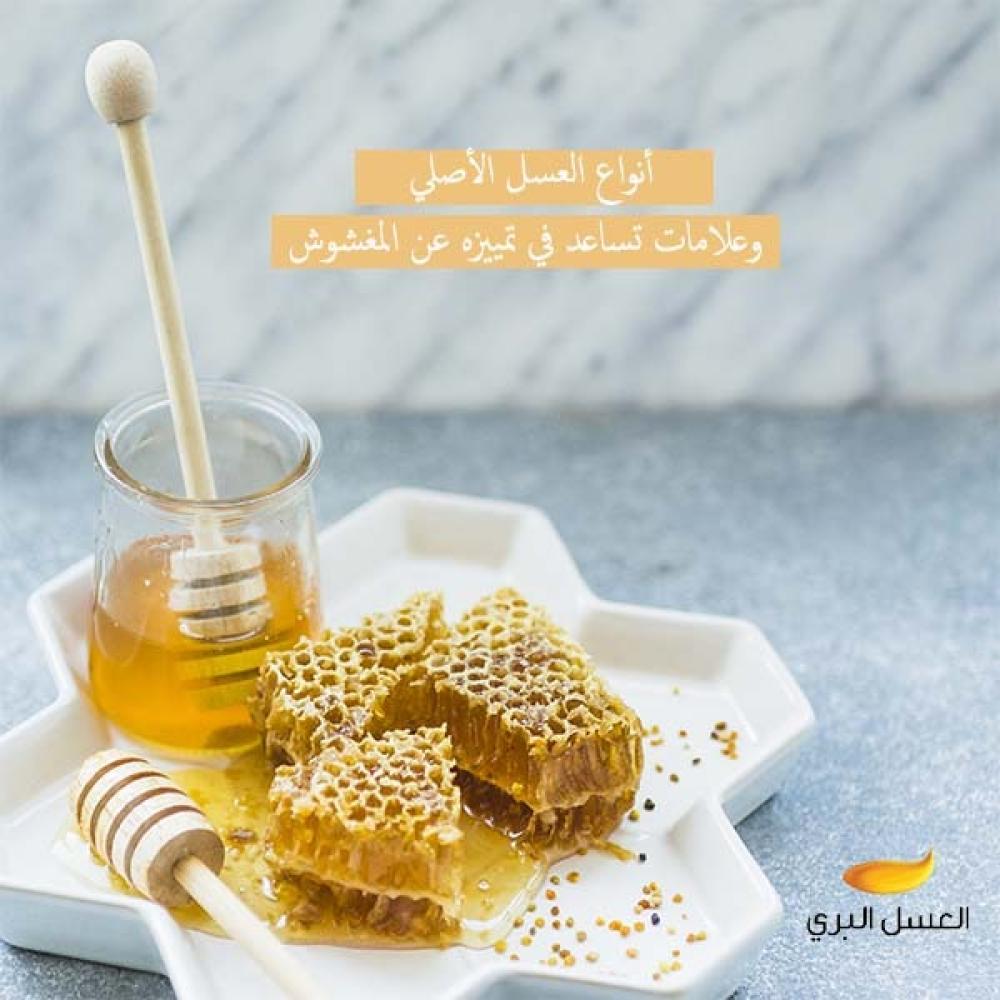
Genuine honey is honey that is extracted entirely from the nectar of natural flowers without any intervention, whether through excessive processing or the addition of artificial substances. Due to the multitude of types, it has become important to learn about the different types of genuine honey and how to distinguish them from adulterated types. Follow us in this article from the Wild Honey Store where we explain the most important types according to their different sources and processing methods, along with tips to help you buy genuine honey. So follow us.
What is genuine honey?
It is 100% natural honey, produced by bees entirely naturally by extracting nectar from various flowers and trees. What distinguishes genuine honey is that it does not contain any artificial substances or additives that would diminish its nutritional and therapeutic value.
This type of honey retains all the nutrients such as vitamins and minerals, as well as natural enzymes. It may occasionally contain some impurities, and it does not contain any artificial sugars, flavorings, or artificial colors.
What are the types of genuine honey?
The types of genuine honey vary according to several factors. Genuine types can be divided according to the source of the nectar from which the honey was extracted, as well as according to the location, methods of purification and processing, and all these factors have an effect on the appearance of different types in color, taste, and texture.
Types of genuine honey according to the source of the nectar
Basically, honey can be divided into single-source original honey, meaning that it is honey that has been extracted from a single source of nectar, whether that source is from flowers or trees.
It can also be classified as multi-source original honey, where the nectar used is obtained from various sources, whether it be a group of trees or flowers.
Types of genuine honey according to environment
The environment in which bees rely to extract nectar varies and can be divided into three main categories: mountainous regions, desert regions, and agricultural regions. Species can be further categorized as follows:
- Mountain honey is honey that comes from plants or flowers that grow on the slopes of mountains, and it may also be extracted from caves located high in the mountains. Mountain honeys are often more effective than others, such as Sidr honey and Kashmiri honey of various types.
- Desert honey is honey that bees produce from the flowers of desert plants, as well as shrubs and trees that grow within the desert, extracting their nectar to produce natural honey with characteristics and features that make it concentrated compared to some types of honey such as acacia honey.
- Honey is extracted from agricultural areas, whether fields or farms, where bees rely on the flowers of plants and fruits, such as citrus honey and clover honey.
Learn about the types of Hadhrami honey
Types of genuine honey according to processing and purification methods
Besides the source of honey and where it is extracted, it can be classified according to the method of purification, and can be divided as follows:
- Raw, genuine honey is honey obtained in its natural form without purification or treatment by any means, whether thermal or chemical. Therefore, this type may contain pollen or beeswax, and it retains all its elements of enzymes, minerals, and vitamins.
- Pure, filtered honey is natural honey that has undergone some simple processes aimed at purifying it, which may make it less beneficial than the raw type.
- Pasteurized honey may be less beneficial than the previous two types because it has undergone processing such as heating, which may cause it to lose some of its properties and benefits.
Despite the different classifications of types of original honey, there are some types that stand out and are classified as original honey, especially mountain and desert honeys such as Sidr honey and Talh honey, in addition to some rare types such as Manuka honey.
You can learn about the best different types of natural honey
How can you distinguish genuine honey from adulterated honey?
There are a number of methods that can help distinguish between genuine and counterfeit varieties, including texture and taste, along with some tests that may make it easier to differentiate between them, such as the water method, the tissue method, or using fire.
Here are some more ways that may help you distinguish genuine honey from adulterated honey.
Does a difference in the color and taste of honey mean that it is not genuine?
The variation in honey's color and taste is normal, especially with different types. It is natural for the color to vary according to the flower and the nature of the place from which the honey was extracted. This is why we find that some types are dark, while others have a golden color.
But if the taste is strange and the consistency of the honey is significantly different from its normal state, this may be an indication of the presence of chemicals or artificial additives in the honey.
Learn about the different colors of honey in detail
Are the benefits of all types of pure honey the same?
The benefits of pure honey vary depending on its type and source. Some types may be more beneficial for the digestive system, while others are more beneficial for the respiratory system, and still others for immunity. However, overall, pure honey helps with:
- Boosting immunity.
- Improved digestion.
- Improve skin health.
- Increase the body's energy level.
- Improving the ability to sleep.
- Treating infections.
- Improving heart function.
Tips before buying genuine honey
Here are some tips from the experts at the Wild Honey Store to ensure you get genuine honey, the most important of which are:
- Buy from reputable stores with a good reputation.
- Pay attention to the contents of the package and the labels on it.
- Checking the properties of honey, including viscosity, color, and smell.
- The question concerns the source and environment of the honey.
- Consult experts in the field of honey.
Obtaining genuine honey can be difficult, especially with the proliferation of stores and the variety of types. However, choosing a store with a good reputation and experience will ensure that you get genuine honey, and that is what we offer at the Wild Honey Store. Choose from our products what suits your taste.
Frequently Asked Questions
What is meant by genuine honey?
It is 100% natural honey without any chemical or artificial additives.
How can I be sure the honey is genuine?
This can be confirmed through texture, color and smell with some simple tests, and most importantly by buying from a trusted store.
Does a difference in the taste of honey mean that the honey is not natural?
The taste can vary from type to type, but the presence of a strange taste may sometimes be an indication that the honey is unnatural or contains artificial substances.
Is pasteurized honey genuine honey?
It is honey that has undergone many processing and purification processes, which has caused it to lose some of its natural properties and nutritional value.
Is crystallized honey adulterated?
No, because the crystallization property is one of the most important characteristics of natural honey.
Does genuine honey freeze in the refrigerator?
Yes, honey can freeze due to the cold because of the natural crystallization process.
Does fake honey mix with water?
Fake honey usually mixes quickly with water, unlike natural types which may take some time and may even settle as a clump at the bottom of a glass of water.